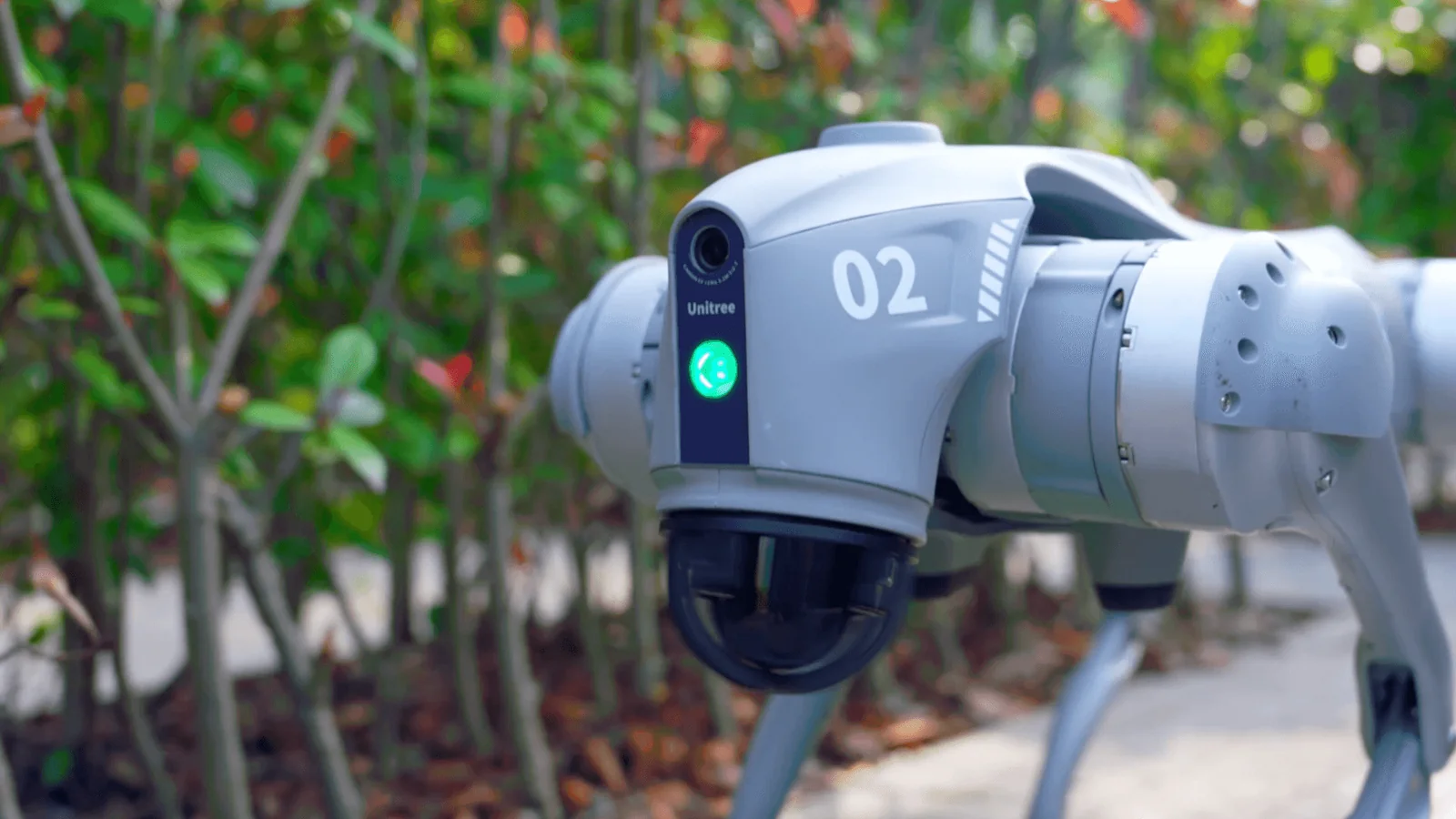
A security robot dog works a repeatable route: a quadruped with LiDAR, a camera and connectivity that brings images, maps and alerts to a person. It does not decide on its own and does not intervene with anyone. It is there to see and measure what happens along that route, at night or in quiet areas.
Security robot dog: what it can and cannot do
With LiDAR, a camera and accessories it can patrol, stream video, run thermal imaging and detect gas.
| What it can do | What it cannot do |
|---|---|
| Follow a mapped route and repeat it | Replace a security guard or a licensed security company |
| Carry an HD camera, thermal camera, LiDAR, gas sensor and speaker | Stop, chase or block a person |
| Stream video and data to a control room | Detect an intrusion without configuration and checks |
| Climb steps and move over uneven ground | Guarantee 24/7 continuity without recharging and supervision |
Teleoperated and autonomous patrols
In teleoperated patrol, an operator drives the robot with an app or remote control and watches the video in real time. It needs a stable network and constant attention. This is the way to start without integration software.
In autonomous patrol, the robot follows a map and a route. The Go2 builds a 3D map with its LiDAR and lets you set a route from the app; a patrol with alerts, verification and escalation, however, needs integration software. Moving autonomously does not mean deciding autonomously: someone has to watch the alerts and decide.
| Teleoperated | Autonomous | |
|---|---|---|
| Who drives | An operator, with real-time video | The software, with human supervision |
| What it needs | Network, video, remote control or app | Map, waypoints, SDK and integration |
| When it makes sense | Initial period, events, complex areas | Repetitive patrols in stable environments |
| Main limit | Constant attention, latency, coverage | Unexpected obstacles, people, weather, map to update |
Versions in the same family do not have the same capabilities. Go2 Air and Pro cannot be programmed; the Go2 Edu versions have an SDK and ROS 2. The differences are covered in the Go2 vs Go2 Pro guide. The A2 and B2 support custom software development (SDK).
Video streaming and control-room integration
On the Go2 Pro, X and EDU, the 4G module with eSIM allows remote video and commands through the app; locally there is Wi-Fi 6. Unitree documentation describes WebRTC for video, audio, point cloud and commands. The developer documentation also describes an H264 stream at 720p and 15 Hz over UDP.
For the control room, what matters is who watches, where footage is recorded, for how long and who has access; the manufacturer's app is not a VMS, so gateways or integration are needed.
| Channel | What it carries | Watch out for |
|---|---|---|
| Wi-Fi 6 | Local video and control | Coverage, interference, roaming |
| 4G with eSIM | Remote video and control on Go2 Pro, X and EDU | Coverage, costs, latency; the Unitree note lists 43 European countries (excluding Ukraine) for the non-Chinese version |
| WebRTC | Video, audio, point cloud and commands through the app | May route through a TURN server: include it in the privacy assessment |
| H264 over UDP | 720p stream at 15 Hz in the Go2 developer documentation | Requires a gateway, recording and software development |
| Ethernet | Data and telemetry on A2 and B2 | Integration with the customer's network and security rules |
Sensors useful on a patrol
- 4D or 3D LiDAR: map, localisation and obstacles; it does not replace visual verification.
- HD camera: context and detail.
- Dual-spectrum gimbal: in the remote control with screen for Go2 and Go2-W, a 640×512 thermal sensor in the 8-14 μm band, €14,674 excluding VAT from the price list. Useful for people and heat sources, it is not a certified measurement.
- Gas sensor: module for Go2 and Go2-W, €2,201 excluding VAT from the price list, measuring oxygen, carbon monoxide and carbon dioxide, methane, hydrogen sulphide and benzene.
- Searchlight, voice and beacon: 3-in-1 module in the remote control with screen for Go2 and Go2-W (searchlight, voice broadcast, red-blue beacon), €6,603 excluding VAT from the price list.
The declared payload is about 7-8 kg on the Go2 (up to 12 kg on X and EDU), 25 kg on the A2 and over 40 kg on the B2. Full comparison in the quadruped for industrial inspection guide.
Battery life and real limits
Declared runtimes depend on payload, temperature, wind, floor and route duration. Data from the official Unitree pages:
| Specification | Go2 | A2 | B2 |
|---|---|---|---|
| Weight with battery | about 15 kg | about 42 kg | about 60 kg |
| Ingress protection | not stated by the manufacturer | IP56 (A2 Pro: main components IP67) | IP67 |
| Step or stair | about 15-16 cm | maximum step 30 cm | stairs of 20-25 cm, obstacles up to 40 cm |
| Slope | 30-40° depending on version | about 45° | over 45° |
| Runtime with payload | not stated by the manufacturer | over 3 h with 25 kg | over 4 h with 20 kg |
| Operating temperature | not stated by the manufacturer | from -20 to 55 °C | from -20 to 55 °C |
Weather. For outdoor use, conditions need checking: deep snow, sand and mud are not declared.
Battery life. Go2: 1-2 hours on Air, Pro and X, 2-4 hours on Go2 Edu versions. A2: over 5 hours and 20 km without payload, over 3 hours and 12.5 km with 25 kg. B2: 4-6 hours, over 5 hours and 20 km without payload, over 4 hours and 15 km with 20 kg. The A2 has hot-swappable batteries; the B2 has a removable battery and optional autonomous charging.
ATEX. Standard versions of the Go2, A2 and B2 do not carry ATEX certification and must not be used in areas where an explosive atmosphere may occur. The B2-Ex is a separate variant, not in the End-User price list. A gas sensor does not make the robot ATEX: it measures the atmosphere, it does not certify the machine.
Privacy and video surveillance: the robot is a mobile camera
A robot dog with a camera records identifiable people: under data protection law, that is personal data. You need defined purposes, areas and angles, minimisation and short retention periods. The privacy notice must be given before the monitored area, with a visible sign.
Where video surveillance rules apply, the principles are the same: defined purpose, short retention, restricted access and a visible notice. As a benchmark, Italy's data protection authority (Garante) sets a maximum of 7 days for urban video surveillance and cites 24 hours as sufficient for a small shop; encryption is required for wireless transmissions. No prior authorisation is needed, but a system that automatically detects unusual behaviour requires a data protection impact assessment where the risk is high.
In practice: a sign, a record of processing activities, short retention, named access and masking of irrelevant areas. Video surveillance must not become remote monitoring of workers.
General information, not legal advice. Privacy assessment and area classification depend on the specific case: involve a consultant before installing the system.
PPE and human supervision
The robot must not be used as protection. Anyone intervening wears the PPE required by the risk assessment: helmet, safety footwear, high-visibility clothing and hearing protection where needed.
You need a route supervisor, a reachable emergency stop, a recovery procedure and a person watching the alerts.
Machinery Regulation from 20 January 2027
From 20 January 2027, Regulation (EU) 2023/1230 replaces Directive 2006/42/EC. The European Commission confirms the date and sets out requirements for safety functions using AI and for the cybersecurity of relevant software.
For a security robot dog, three points matter: an autonomous mobile machine requires a protected zone or detection of people and obstacles; critical software and data must be protected from tampering; anyone who substantially modifies the robot, including through software, may take on the obligations of a manufacturer. A robot placed on the market before 20 January 2027 in conformity with the directive remains governed by the directive.
The checklist is in the 2027 Machinery Regulation guide.
How much does a security robot dog cost
Abra Robotics price list, excluding VAT: Go2 Air €2,576, A2 Standard €30,814, B2 €66,828. The full ranges:
| Family | From | To |
|---|---|---|
| Go2 / Go2-W | €2,576.19 | €38,738.22 |
| A2 / A2-W | €30,814.49 | €49,743.39 |
| B2 / B2-W | €66,827.62 | €104,182.33 |
The ranges cover the robot configurations in the price list, from base to fully equipped; spare batteries and accessories are extra. Details in robot dog price and the price list.
Frequently asked questions
What is the difference between teleoperated and autonomous patrol for a security robot dog?
In teleoperated mode the operator drives the robot and sees the video in real time; in autonomous mode the robot follows a map, but alerts and exceptions still go to a person.
Can a security robot dog replace a security guard?
No. It carries sensors and video to a specific point, but it does not intervene with people and does not replace a security service.
Does a security robot dog work in the rain and at night?
It depends on the model: the Go2 does not state an IP rating, the A2 is IP56 and the B2 is IP67. Heavy rain, snow, sand and mud need checking.
How much does a security robot dog cost?
From the Abra Robotics price list, excluding VAT: Go2 Air €2,576, A2 Standard €30,814, B2 €66,828. Spare batteries and accessories are extra.
Do I need a privacy notice for a robot dog with a camera?
Yes. Images are personal data: you need a notice before the monitored area, a defined purpose, short retention and limited access. If the system automatically detects unusual behaviour, a data protection impact assessment may be required.
Are Unitree robot dogs ATEX certified?
Standard versions of the Go2, A2 and B2 do not carry ATEX certification. Unitree has a separate B2-Ex variant, not in the End-User price list, which must not be confused with the standard B2.
Sources
- Unitree, Go2, specifications and 3D mapping
- Unitree, A2, specifications and battery life
- Unitree, B2, specifications and battery life
- Unitree, Multimedia Services, H264 720p at 15 Hz over UDP
- Unitree, Architecture Description, WebRTC for video, point cloud and commands
- Garante per la protezione dei dati personali, Video surveillance ruling, 8 April 2010
- Garante per la protezione dei dati personali, Video surveillance, updated FAQ
- European Commission, Machinery and application date
- Unitree, B2-Ex, explosion-proof variant separate from the B2
- Regulation (EU) 2023/1230, official text on EUR-Lex