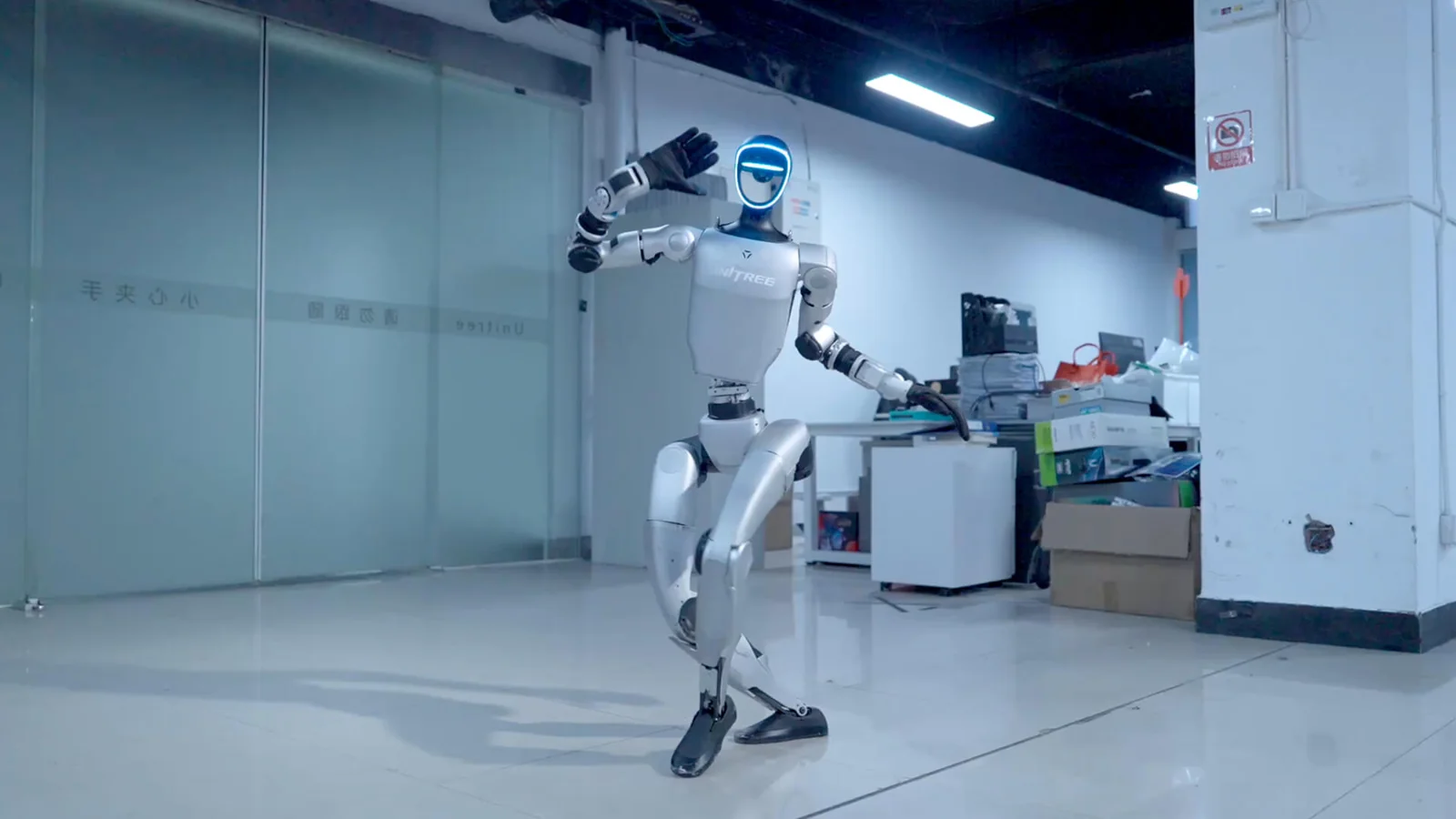
Anyone looking for a humanoid robot for the home today finds two separate offers. On one side are the Unitree platforms on the public price list, sold to companies, universities and laboratories. On the other are the home robots that have been announced, such as the 1X NEO, which can be reserved but are not yet a product in regular delivery.
General information, not legal advice. Before using a humanoid at home or at work, check the risk assessment and the product documentation.
What a humanoid you can buy today actually does
The R1 and G1 are the cheapest Unitree humanoids with legs on the price list. The figures come from the official product pages.
| Item | Unitree R1 | Unitree G1 |
|---|---|---|
| Height | 1230 mm | 1320 mm |
| Weight with battery | about 27 kg (Air), 29 kg (R1/EDU) | about 35 kg |
| Degrees of freedom | 20 (Air), 26 (R1), 26-40 (EDU) | 23 (base), 23-43 (EDU) |
| Arm payload | about 2 kg | about 2 kg (base), 3 kg (EDU) |
| Stated runtime | about 1 hour | about 2 hours |
| Programming with the SDK | EDU only | EDU only |
| Stated warranty | 6 months (Air), 8 months (R1), 12 months (EDU) | 8 months (base), 18 months (EDU) |
| List price of the base version | R1 Air €7,190 | G1 Basic €19,809 |
The documented functions are few and specific. The R1 has a built-in multimodal model for voice and images, receives OTA updates and offers open control interfaces. The G1 carries a depth camera and a 3D LiDAR, with a 9000 mAh battery and a 54 V 5 A charger. The G1 EDU can be fitted with the Dex3-1 force-controlled hand: 7 degrees of freedom, 2 optional at the wrist, tactile sensors on request. Unitree describes the G1 as driven by imitation and reinforcement learning. These are lab capabilities: someone has to set up the task and supervise the robot.
The R1 page puts the limits in writing: the industry is at an early stage, some of the functions shown are still in development and testing, and people must keep a safe distance from the robot. The G1 page also asks for distance and caution, and tells buyers to understand the limits of humanoids.
What a humanoid robot for the home cannot do
The limit is how reliably it completes a task, more than the mechanics. In practice:
- It does not understand or run a household. There is no documented "clean the kitchen" or "tidy up" function: tasks have to be programmed or handled by an operator.
- It lifts little. Arm payload is about 2 kg on the R1 and the base G1, 3 kg on the G1 EDU, and it varies with posture.
- Its runtime is short. About one hour for the R1 and two for the G1: a full day of testing needs spare batteries.
- It cannot look after itself. It has to be switched on, configured, updated and supervised. It is not an appliance you install and forget.
Humanoid robot for cleaning the house: what really exists
The Unitree product pages on the price list describe no cleaning function at all. 1X, by contrast, presents the NEO as a home robot: its launch announcement mentions folding laundry, organising shelves and tidying rooms. For jobs the robot does not know, the NEO product page provides for a 1X Expert who supervises its actions remotely, at scheduled times.
For floors, robot vacuum cleaners already exist. A humanoid makes sense when the task is handling objects, collecting data or researching locomotion and physical AI.
The announced consumer model: where the 1X NEO really stands
The 1X NEO is reserved on the 1X order page with a refundable $200 deposit. There are two options: Early Access ownership at $20,000, with a three-year warranty and priority delivery, or a subscription at $499 a month. As of October 2026 the page says "US Deliveries start 2026", with no dates for individual customers and no other countries listed. The launch announcement of 28 October 2025 puts the other markets back to 2027, without saying which ones.
The post of 30 April 2026 about the Hayward factory in California says the first NEOs built go to the in-house team for testing in homes, and that "some" customers will receive the robot in 2026, others later. The stated initial capacity is 10,000 units a year. So the NEO is still a pre-order, not a product you can buy.
According to the 1X product page, the NEO is 5'6" tall (about 1.68 m), weighs 66 lb (about 30 kg) and has an 842 Wh battery for about 4 hours of runtime, with two hands of 22 degrees of freedom each. These are manufacturer figures, with no independent testing.
How much does a humanoid robot for the home cost
If you still want a humanoid platform, these are the End-User prices from the public price list, in euros excluding VAT (shipping and insurance are quoted in the offer). Each range shows the cheapest and the most expensive configuration of each family listed, including the torso versions without legs.
| Family | From | To | Used for |
|---|---|---|---|
| All humanoids on the price list | €6,295 | €261,776 | Full range, from the R1-A5 torso to the H2 PLUS |
| R1 | €6,295 | €35,217 | Teaching, first projects, development on EDU |
| G1 | €19,809 | €90,829 | Research on locomotion, manipulation, PoC |
| G1-D | €38,005 | €69,993 | Manipulation on a stand or a mobile base |
| R1-D | €12,164 | €35,936 | Two arms, no legs, on a fixed or mobile base |
The two prices are not for equivalent products: the NEO at $20,000 is a consumer pre-order for the United States, while the G1 Basic at €19,809 is a lab platform with a price list, spare parts and accessories.
For researchers, students and developers
If the purchase comes from a project, the choice depends on what has to run on the robot.
- Teaching. The R1 Air is operated from an app and a remote and cannot be programmed with the SDK. To run students' exercises you need the R1 EDU, from €14,930.
- Research on locomotion and physical AI. The G1 EDU adds programming with the SDK and more degrees of freedom. For teaching and first projects the R1 EDU costs less.
- Software development. Before ordering, check which SDK and ROS 2 packages exist for the version you choose.
- Bench manipulation. If the task is picking and placing objects, a two-arm torso such as the R1-D or G1-D works on a fixed or mobile base: it does not have to keep its balance on two legs.
The point-by-point comparison of the models is in the 2026 humanoid comparison. All configurations are collected on the Humanoids page.
Safety: why it is not a household appliance
A humanoid is a machine with powerful actuators and software that decides how to move. For use in a company or a laboratory in the EU, the reference legislation is the Machinery Regulation (EU) 2023/1230, which becomes mandatory from 20 January 2027; until then the Machinery Directive 2006/42/EC applies. The regulation introduces requirements for machinery with AI-based safety functions and for the cybersecurity of software relevant to conformity.
At home the picture gets more complicated: the robot shares the space with untrained people, pets and unpredictable objects. The Unitree product pages do not describe autonomous use in the home. Any test outside the lab needs a documented risk assessment first. The full regulatory picture is in the article on the 2027 Machinery Regulation.
Frequently asked questions
Is there a ready-to-use humanoid robot for the home?
No, not on the Abra price list. The R1, G1 and H2 are platforms for companies, universities and laboratories, and their product pages do not mention housework.
What can a humanoid robot do to clean the house?
No Unitree humanoid on the price list has a cleaning function. The 1X NEO promises household chores, but for those it does not know it relies on a 1X Expert connected remotely. For floors, the practical answer is still a robot vacuum cleaner.
How much does a humanoid robot for the home cost?
On the public price list, Unitree humanoids range from €6,295 (R1-A5 Standard, torso) to €261,776 (H2 PLUS Ultimate N), excluding VAT. The 1X NEO can be pre-ordered at $20,000 or as a subscription at $499 a month.
Where can you buy a humanoid robot for the home?
Abra Robotics supplies the Unitree humanoids in the UK, Ireland and internationally, with support in English, as platforms for work and research. For the 1X NEO, as of October 2026, the order page lists deliveries in the United States only; 1X has announced the other markets from 2027.
Can a home humanoid robot be programmed?
The Unitree models can, but only in the EDU versions: the R1 EDU, G1 EDU and H2 EDU accept programming with the SDK. The Air and Basic versions are operated from an app and a remote.
Sources
- Unitree, official R1 product page (specifications, functions, warnings): unitree.com/R1
- Unitree, official G1 product page (specifications and equipment of G1/G1 EDU): unitree.com/g1
- Unitree, official G1-D product page (platform for manipulation and data collection): unitree.com/G1-D
- Unitree, official H2 product page (specifications and H2/H2 EDU versions): unitree.com/H2
- 1X Technologies, NEO launch announcement of 28 October 2025 (pre-order, prices, household tasks, other markets from 2027): 1x.tech/discover/neo-home-robot
- 1X Technologies, NEO product page (specifications, remote supervision by Experts): 1x.tech/neo
- 1X Technologies, NEO order page (purchase options and delivery status): 1x.tech/order
- 1X Technologies, NEO production update of 30 April 2026: 1x.tech/discover/neo-factory
- European Commission, Machinery Regulation (EU) 2023/1230 and application from 20 January 2027: single-market-economy.ec.europa.eu
- Abra Robotics, Unitree End-User price list (prices excluding VAT, accessed on 19 October 2026)