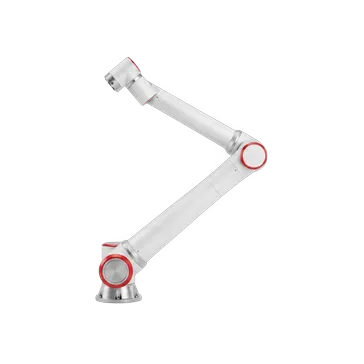
The price of a welding cobot is built around the part and the process. The arm's list price is the first item, not the total: a quote that does not separate torch, welder, positioning, fume extraction, guarding and commissioning does not let you compare two offers. The same FR10 can end up at very different costs from one workstation to another.
Welding cobot: the cost lines of a workstation
A welding cell divides into six blocks. Each has a price that depends on the part and the process, not only on the cobot model.
| Item | What it includes | What changes the price |
|---|---|---|
| Cobot | 6-axis arm, controller, teach pendant, cables, software | Payload, reach, repeatability, IP rating, mounting bracket |
| Torch and welder | Welding power source, torch, wire feeder, gas, cooling, robot interface | MIG/MAG or TIG process, current, duty cycle, water-cooled torch, torch cleaning |
| Table or positioner | Work surface, fixture, rotator or motorised positioner | Part weight and size, stroke, accuracy, number of stations |
| Fume extraction | Source capture, filter, ductwork, ventilation | Process, fume volume, torch or booth capture, system test |
| Guarding and safety | Risk assessment, scanners, barriers, interlocks, curtains, CE marking | Layout, access points, speed, need for fencing |
| Programming and commissioning | Programs, parameters, TCP calibration, tests, training, documentation | Number of programs and variants, fixture complexity, testing on the real part |
Two workstations with the same FR10 can cost very different amounts: the part, the welder and the extraction change. A single total without a breakdown and layout is not reliable. The same applies to cobot palletising.
The cobot: FR10 as the basis for light welding
The Fairino FR10 has a rated payload of 10 kg (14 kg maximum), 1,400 mm reach, repeatability of ±0.05 mm and a TCP speed of 1.5 m/s. It weighs around 40 kg and is rated IP54, with IP65 optional.
For welding, payload is the first figure, but the torch, wire feeder and cables add weight and bulk at the wrist. Fairino states a welding software package with offline simulation, graphical interface, cobot/welding set interlock and compatibility with welding sets from different brands. The Abra product page gives the price of the product alone: torch, welder, safety and integration are separate items.
For heavier parts or longer reach, the Fairino catalogue offers the FR16 (16 kg, 1,034 mm) and FR20 (20 kg, 1,854 mm). In a welding configuration they are quoted per project: the arm price alone does not define the cell. To choose a model, see Cobot: what they are and how they work.
Torch and welder: the process comes first
MIG/MAG and TIG are not variants of the same setup. They change the power source, torch, gas and wire handling. For the TPS/i, Fronius offers water-cooled or air-cooled versions, integrated or external wire feeder, with torch cleaning and automatic torch change as options. These choices go into the quote on top of the robot.
On a cobot the interface also matters. The robot has to control arc start and stop, current, voltage and wire feed, and receive alarms from the welding set. Fairino states the cobot/welding set interlock and the option to use welding sets from different brands. If the welder is already on site, the quote must say whether integration is included or remains the customer's responsibility.
The torch changes with the duty cycle. Water cooling, automatic cleaning and scheduled torch changes add components and maintenance, but reduce stoppages on long cycles. The choice depends on the arc hours per day.
Table or positioner: the part has to stay still
A welding table with fixtures has fewer axes and movements than a motorised positioner. A positioner, however, brings the seam into position, cuts loading and unloading time and can serve two stations. For long, heavy parts or seams on several sides, it is often the item that decides throughput.
The fixture has to be designed: datums, clamps, torch access, room for thermal distortion and a quick way to change parts. If the quote mentions a "work table" without stating capacity, stroke and repeatability, a figure needed to compare offers is missing.
Fume extraction: size it in, don't add it later
The HSE, the UK authority for health and safety at work, states that all welding fume can cause lung cancer and that the law requires the risk to be controlled. Source capture is the recommended method: extraction at the torch for MIG, an extracted bench for small and medium parts, a booth for large ones; if extraction is not enough, general ventilation and respiratory protection.
In a robotic cell, extraction belongs in the design, not at the end of the build. Capture, filter, ductwork, fan, air discharge and the commissioning test all add cost. The HSE also warns that local exhaust ventilation may not always capture all the fume in a robotic cell: operator distance and mechanical ventilation become part of the design. If the quote does not mention extraction, an item and a risk are missing.
Guarding and safety: assess the cell
General information, not legal advice. The safety of a cell depends on the specific application and on the risk assessment.
ISO 10218-1:2025 covers the robot as an incomplete machine; ISO 10218-2:2025 covers integration, commissioning and the cell. ISO/TS 15066:2016 deals with collaborative systems. The 2025 revision of ISO 10218 incorporated much of TS 15066 into Part 2 and does not use the term "collaborative robot": only the application can be designed and validated as collaborative.
Welding adds hazards the arm alone does not have: electric arc, sparks, hot parts, UV and infrared radiation, fume. ISO 10218-1 says so explicitly: applications such as welding create additional hazards, to be managed in the application design under ISO 10218-2. Welding curtains and screens should meet EN ISO 25980, as the HSE notes.
The cobot can work without fencing only if the risk assessment allows it. Scanners, barriers, interlocks or physical guarding are added where needed. The assessment covers the cell, not the arm bought separately. From 20 January 2027 the EU reference becomes the Machinery Regulation (EU) 2023/1230.
Programming and commissioning
Programming a weld seam takes more than recording points. The torch TCP is calibrated, current, voltage and speed are checked on a test piece, the cycle is tried on the real part, scrap is checked and operators are trained. Fairino offers graphical programming and offline simulation; fine-tuning on the part is still necessary.
In the quote, ask how many hours of programming and training are included and how many part variants the price covers. A cell that welds one part number is different from one that changes part every day. Also ask which tests are carried out before delivery and with what acceptance criteria.
Light welding and industrial welding: two different calculations
Before choosing a model, it helps to separate two cases: light welding and industrial welding. The table compares the criteria that change the numbers.
| Criterion | Light welding | Industrial welding |
|---|---|---|
| Parts | Small or medium, variable batches | Large or heavy, long cycles |
| Thickness | Thin and medium | Medium and heavy |
| Throughput | Low or medium | High and continuous |
| Robot | FR10, FR16, FR20: 10-20 kg, reach 1,034-1,854 mm | Robots with higher payload and reach |
| Positioning | Compact table or positioner | Motorised positioner, multiple stations |
| Fume | Source capture | Booth or dedicated extraction |
| Safety | Risk assessment, possible shared space | Fencing and interlocks |
| Shifts | One or two | Two or three |
A cobot can weld parts that look industrial, but force and speed limits and the operator's proximity change the economics. With high throughput and a fixed cycle, an industrial robot works better; with variable batches and manual loading, a cobot makes more sense. Industrial welding starts from higher payload and reach and looks at the complete cell.
What to ask in the quote
- Is the price for the cobot alone or the complete workstation?
- Which model and what payload margin? Has the weight of the torch, wire feeder and cables been counted?
- Which welder and which torch? Are they included or supplied by the company?
- Is the table or positioner included? With what capacity, stroke and repeatability?
- Is fume extraction included? What type of capture, filter and system test?
- Who carries out the risk assessment and CE marking of the cell? What guarding is planned?
- How many hours of programming, training and testing on the real part are included?
- What is excluded: transport, installation, gas, compressed air, building work, welding procedure qualification?
If the offer does not separate the items, it is impossible to see where you save and where the cost passes to the customer.
What Abra Robotics does
Abra Robotics provides the Unitree range in the United Kingdom, Ireland and internationally, with support in English. For Fairino cobots we support the workstation assessment: part, process, layout, extraction and safety. The arm price is the starting point; the quote is built on the items in this guide. To frame the application, start with the assessment, with the updated cobot catalogue on the Cobots page.
Frequently asked questions
How much does a welding cobot cost?
The Fairino FR10 arm has a list price from €10,387 excluding VAT. A complete workstation adds torch and welder, table or positioner, fume extraction, guarding and commissioning: the total depends on the process and the part.
Can a cobot weld without guarding?
Only if the risk assessment of the cell allows it. Welding adds arc, sparks and hot parts: scanners, curtains or guarding are decided by the application, not by the robot's name.
Which Fairino cobot is suitable for light welding?
The FR10, with 10 kg payload and 1,400 mm reach, is the recommended basis for light welding. For heavier parts or longer reach, FR16 and FR20 are quoted on the configuration.
What should a welding cobot quote include?
Robot, torch and welder, table or positioner, fume extraction, risk assessment and guarding, programming, testing and training. Also ask what is excluded.
Is a cobot or an industrial robot better for welding?
It depends on the part, throughput and shifts. A cobot pays off on variable batches and low or medium throughput; an industrial robot on long cycles, heavy loads and continuous production.
Sources
- Fairino, FR10 product page (payload, reach, repeatability, TCP speed, IP rating, weight)
- Fairino, FR16 product page and FR20 product page (payload and reach)
- Fairino, welding application and Welding Software
- ISO, ISO 10218-1:2025, Robotics, Safety requirements, Part 1: Industrial robots
- ISO, ISO 10218-2:2025, Industrial robot applications and robot cells (incorporation of ISO/TS 15066 and the term "collaborative robot" not used)
- ISO, ISO/TS 15066:2016, Collaborative robots
- HSE, Welding fume: protect your workers
- HSE, Controlling the risks from welding
- Fronius, TPS/i, MIG/MAG welding system (components and configurations)
- Regulation (EU) 2023/1230 on machinery: EUR-Lex