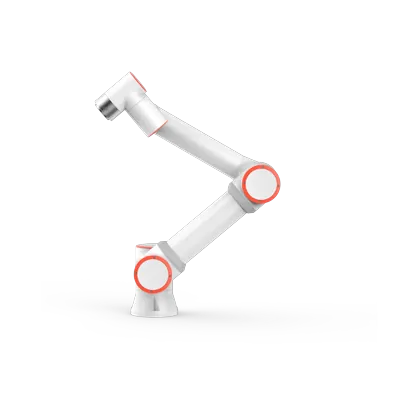
A cobot, short for collaborative robot, is a robot arm built to work next to a person in the same space, without a fixed cage. Before models and prices, one distinction: a "lightweight" arm is not enough to make an application collaborative, and not every workstation with a cobot can do without guarding.
What is a cobot: definition and reference standards
ISO 10218-1:2025 defines an industrial robot as an automatically controlled, reprogrammable, multipurpose manipulator, programmable in three or more axes. The cobot is not a separate category in the standards: it is a robot designed with force, power and speed limits that allow it to share space with people.
The technical specification ISO/TS 15066:2016 describes collaborative operation as the state in which a purposely designed robot system and an operator work within a shared workspace. So "collaborative" describes the application as a whole (robot, gripper, workpiece, environment), not the arm on its own. The 2025 revision of ISO 10218 has absorbed most of the content of ISO/TS 15066 and says so explicitly: the term "collaborative robot" is not used in the standard, because only the application can be developed, verified and validated as collaborative.
Cobots and industrial robots: the differences
Industrial robots and cobots share the same technical basis: a 6-axis arm with a controller. What changes is how they are put to work.
| Parameter | Industrial robot | Cobot |
|---|---|---|
| Guarding | Almost always fixed | Often none, if the risk assessment allows it |
| Speed | High, with strong accelerations | Limited by force, power and momentum |
| Payload | From tens to hundreds of kg | Typically 3-30 kg |
| Programming | Offline or teach pendant | Also by hand guiding |
| Entry cost | Higher, with cell and guards | Lower, with simpler installation |
In practice an industrial robot pays off with high throughput, heavy loads and cycles that never change. A cobot pays off with light loads, changing formats, little space and workstations where a person often comes close to the arm.
How a cobot works: the four modes of collaboration
ISO/TS 15066 lists four collaborative operation techniques, used on their own or combined:
- Safety-rated monitored stop: the robot stops when the operator enters the area; person and robot never move at the same time.
- Hand guiding: the operator moves the arm by hand to record the points of the cycle.
- Speed and separation monitoring: scanners or vision measure the distance and slow the robot down as the operator approaches.
- Power and force limiting: the robot limits force, power and speed so that accidental contact does not cause injury. This is the typical cobot mode, with pain thresholds for different body regions given in Annex A of the specification.
A Fairino cobot relies mainly on power and force limiting: the joints have closed-loop torque feedback, as stated in the Fairino datasheet. The right mode, however, is chosen for the application, not for the model.
What a cobot is used for: machine tending, palletising, welding
Typical applications:
- Machine tending: loading and unloading parts on lathes, milling machines and presses.
- End-of-line palletising: placing boxes on EUR pallets. Costs and timescales are covered in the guide to cobot palletising.
- Welding: the cobot carries the torch along repeated seams. You need a cell with a power source, torch and dedicated table; the arm is only one part of it.
- Pick & place and light assembly: picking and placing components with an electric or pneumatic gripper.
In the warehouse a cobot is often combined with an AMR: the arm picks, the mobile robot carries. For end-of-line and handling, the overview is on the Manufacturing and logistics page.
How much does a cobot cost: Fairino list prices
Fairino arms in the Abra price list run from €5,448 (FR3) to €16,256 (FR30), excluding VAT. The gripper, mounting kits and integration are quoted separately.
| Model | Payload | Reach | Price from (excl. VAT) |
|---|---|---|---|
| Fairino FR3 | 3 kg | 622 mm | €5,448 |
| Fairino FR5 | 5 kg | 922 mm | €6,252 |
| Fairino FR10 | 10 kg | 1,400 mm | €10,387 |
| Fairino FR16 | 16 kg | 1,034 mm | €10,450 |
| Fairino FR20 | 20 kg | 1,854 mm | €14,677 |
| Fairino FR30 | 30 kg | 1,403 mm | €16,256 |
Payload and reach come from the official Fairino datasheets; prices from the Abra cobot catalogue. Palletising cells cost more than the arm alone: they include the workstation (from €10,230 on its own), assembly, pattern programming and basic commissioning. The FR10 cell starts from €30,690, the FR20 version from €36,828.


Safety and risk assessment
General information, not legal advice. How a robot is classified and the obligations that follow depend on the actual application.
Collaboration is not "switched on" because the model is called a cobot. It is decided by a risk assessment of the whole application: robot, gripper, workpiece, speed, path and access by people. ISO 10218-2:2025 requires the integrator to assess contact between moving parts and operators and to provide risk reduction measures.
There are two practical consequences. First: a cobot whose gripper holds a hot, sharp or heavy workpiece may need scanners, reduced-speed zones or physical guarding. Second: CE marking covers the whole cell, not just the arm. From 20 January 2027 the reference in the EU becomes the Machinery Regulation (EU) 2023/1230: the details for anyone assembling a cell are in the guide to the 2027 Machinery Regulation.
Cobot or industrial robot: how to choose
Start from three numbers: the weight of the workpiece plus gripper, the line rate and the available space. If the load is under 30 kg, the rate is low or medium and a person needs to come close to the workstation, a cobot is often the right choice. If the load is heavy, the rate high and the cycle always the same, an industrial robot copes better with production. To size payload and reach the method is the same as for palletising: add up the workpiece, the gripper and any accessories, and check the point furthest from the base.
Incentives
A cobot is plant and machinery and may qualify for some UK schemes in 2026, depending on how the project is structured: capital allowances (full expensing, the first-year allowance or the Annual Investment Allowance), R&D tax relief and, for manufacturers in England, Made Smarter Adoption. The overview is in the article Financing a robot in 2026: UK reliefs and leasing. Abra Robotics can provide the quote and technical documentation for your claim or application; we do not give tax or funding advice.
Frequently asked questions
What does cobot mean?
Collaborative robot: a robot arm built to work next to a person, in the same space. For the standards, what is collaborative is the whole application, not the arm alone.
What is the difference between a cobot and an industrial robot?
An industrial robot is faster and carries more, but almost always works behind a fence. A cobot limits force and speed and can work without a cage if the risk assessment allows it.
How much does a Fairino cobot cost?
The arm starts at €5,448 (FR3, 3 kg) and goes up to €16,256 (FR30, 30 kg), excluding VAT. The gripper and integration are quoted separately.
Can a cobot weld?
Yes, with a cell that includes the power source, torch and table. The risk assessment decides whether the cobot's limits are enough or guarding is needed.
Does a cobot always work without guarding?
No. If the risk assessment requires it, laser scanners, barriers or physical guarding are added.
Sources
- ISO 10218-1:2025, Robotics, Safety requirements, Part 1: Industrial robots (definition of industrial robot): iso.org
- ISO 10218-2:2025, Robotics, Safety requirements, Part 2: Industrial robot applications and robot cells: iso.org
- ISO/TS 15066:2016, Robots and robotic devices, Collaborative robots: iso.org
- ISO, "Robots and humans can work together with new ISO guidance" (the four collaborative operation techniques): iso.org
- Fairino, FR3 product datasheet (3 kg payload, 622 mm reach, ±0.02 mm repeatability): fairino.com
- Fairino, FR5, FR10, FR16, FR20 and FR30 product datasheets (payload and reach): Abra product pages in the cobot catalogue.
- Prices: Abra Robotics public price list, excluding VAT, in the cobot catalogue.